
Solar Street Lights: A Smarter Way to Light Outdoor Spaces
Imagine driving down a village road after sunset and seeing a clear, well-lit path without a maze of electrical wires overhead. That is where Solar Street Lights can make a real difference. They use sunlight during the day to provide lighting after dark, making them a practical option for roads, residential societies, farms, parking areas, campuses, and commercial spaces.For places where extending conventional electricity infrastructure is expensive or inconvenient, solar lighting can be especially useful. With the right system design, modern solar lights can offer dependable illumination while reducing dependence on grid electricity.At Sailee Solar, we help customers explore solar solutions suited to their location, lighting requirements, and available sunlight. Whether you are planning lighting for a private property or a larger outdoor area, choosing the right equipment and installation approach matters.
Why Solar Street Lights Are Becoming Popular
Outdoor lighting has traditionally depended on grid electricity, underground cables, poles, switches, and regular maintenance. That setup works well in many locations, but it can become challenging when the area is remote, electricity connections are limited, or infrastructure costs are high.
Solar Street Lights offer a different approach. Instead of drawing electricity from the grid every night, they generate and store energy during daylight hours.
Here are some reasons property owners and organizations consider them:
- Lower dependence on grid electricity : Energy comes from sunlight rather than the conventional power supply.
- Useful for remote locations:They can be installed where extending electrical lines may be difficult.
- Reduced wiring requirements: Standalone systems can minimize the need for underground or overhead electrical connections.
- Automatic operation: Many systems switch on and off automatically according to light conditions.
- Environmentally conscious lighting: Solar energy is renewable and does not require fuel during normal operation.
- Flexible applications: They can be used for roads, gardens, pathways, parking lots, farms, campuses, and more.
Think of it as putting a small power station on top of every lighting pole. During the day, it collects energy; after sunset, it puts that stored energy to work.
How Solar Street Lights Work
The basic working principle is quite simple, even though the technology inside a modern system can be sophisticated.During daylight hours, the solar panel captures sunlight and converts it into electrical energy. A charge controller manages this energy and sends it to the battery. Once darkness arrives, the controller activates the LED light using the stored power.
Main Components
A typical solar lighting system includes:
1.Solar Panel
The panel is responsible for converting sunlight into electricity. Its capacity needs to match the energy requirements of the lighting system and the local solar conditions.
2. Battery
The battery stores electricity generated during the day. This stored energy powers the light during nighttime hours.
3. LED Luminaire
LED technology provides efficient illumination while generally consuming less electricity than older lighting technologies.
4. Solar Charge Controller
The controller regulates charging and helps protect the battery from unsuitable charging or discharging conditions.
5. Pole and Mounting Structure
The pole supports the panel and lighting fixture at the required height and position.
6. Sensors and Controls
Depending on the model, the system may use light sensors, timers, motion sensors, or intelligent controls to manage operation.
What Happens on a Cloudy Day?
Solar lighting systems are designed with energy storage so they do not need direct sunlight every minute they operate. However, several cloudy or rainy days can reduce the amount of energy generated. Battery capacity, panel sizing, lighting schedule, local weather patterns, and system design therefore play an important role.A professional site assessment can help determine the appropriate configuration instead of relying on a one-size-fits-all solution.
Solar Street Lights for Different Applications
One of the biggest advantages of solar lighting is its versatility. The same basic technology can be adapted for different locations and lighting requirements.
Residential Societies
The panel is responsible for converting sunlight into electricity. Its capacity needs to match the energy requirements of the lighting system and the local solar conditions.
Rural Roads and Village Areas
Remote roads do not always have convenient access to electrical infrastructure. Solar-powered lighting can provide illumination without requiring every lighting point to be connected to the grid.For villagers, the difference can be surprisingly practical. A previously dark stretch of road becomes easier to navigate after sunset, helping pedestrians, cyclists, and drivers see the path more clearly.
Farms and Agricultural Properties
Farm entrances, pathways, storage areas, and boundaries may require lighting without needing a complicated electrical connection throughout the property.
Parking Areas
Commercial buildings, schools, offices, and residential complexes often have outdoor parking spaces that require lighting after sunset. Properly positioned solar lights can provide illumination while reducing reliance on grid power.
Industrial and Commercial Premises
Warehouses, factories, construction sites, and commercial properties can consider solar lighting for selected outdoor areas, particularly where independent lighting is useful.
Parks and Public Spaces
Depending on the model, the system may use light sensors, timers, motion sensors, or intelligent controls to manage operation.
Residential Societies
Dark internal roads, entrances, walking paths, and parking areas can benefit from well-planned outdoor lighting. Solar lighting may be particularly useful for areas where new electrical cabling would require additional civil work. Benefits of Solar Street Lights The appeal of Solar Street Lights goes beyond simply saving electricity. Their value often comes from combining energy independence, flexible installation, and reduced infrastructure requirements.
1. Uses Renewable Energy
The panel is responsible for converting sunlight into electricity. Its capacity needs to match the energy requirements of the lighting system and the local solar conditions.
2. Reduced Grid Dependence
Because the system generates and stores its own energy, it can operate independently of the conventional electricity supply.
3. Potentially Lower Operating Costs
After installation, the system does not need to purchase electricity from the grid for its normal operation. Actual savings depend on system cost, electricity rates, lighting hours, maintenance, and other factors.
4. Easier Installation in Some Locations
Standalone lighting can reduce the need for extensive electrical cabling. This can be useful for open spaces, pathways, farms, and areas where trenching or wiring is inconvenient.
5. Automatic Nighttime Lighting
Many systems are designed to turn on automatically when ambient light falls below a certain level. There is no need for someone to manually operate every light.
6. LED Efficiency
Modern LED fixtures can provide substantial illumination while using comparatively little electrical power.
7. Scalable Solutions
A project can be designed around its actual lighting requirements. A small property may need only a few poles, while a larger development may require a complete lighting layout.
Choosing the Right Solar Street Lights
Buying a solar light is not simply a matter of choosing the brightest model available. The correct system depends on the site.
Consider the Available Sunlight
The solar panel needs adequate exposure to sunlight. Nearby buildings, trees, towers, and other structures can create shadows and reduce energy generation.
Check the Required Lighting Area
Ask where the light needs to fall rather than focusing only on the lamp’s wattage. Pole height, LED optics, spacing, and installation angle all influence the final result.
Evaluate Battery Capacity
The battery determines how much energy can be stored for nighttime operation. A suitable design should consider expected operating hours and local weather conditions.
Consider Weather and Environment
Outdoor equipment faces rain, dust, heat, humidity, and temperature changes. Choosing components appropriate for the installation environment can support long-term performance.
Look at the Complete System
A cheaper component does not necessarily mean a cheaper project in the long run. Consider the panel, battery, LED fixture, controller, pole, installation, warranty, maintenance, and after-sales support together.
Installation and Maintenance of Solar Street Lights
Professional installation can make a noticeable difference to system performance.
Before installation, the site should ideally be assessed for:
- Solar exposure
- Pole locations
- Road or pathway width
- Required lighting coverage
- Shadow-producing objects
- Mounting conditions
- Battery and equipment requirements
- Expected nighttime operating hours
Once the poles are installed, the panels should have appropriate orientation and an unobstructed view of the sky.
Maintenance Tips
Solar lighting generally requires less routine attention than some conventional lighting systems, but “maintenance-free” should not be taken literally.
Regular checks may include:
- Cleaning dust and dirt from solar panels
- Inspecting cables and connections
- Checking the pole and mounting structure
- Monitoring battery performance
- Checking LED operation
- Removing objects that create new shadows
- Reviewing system performance after extreme weather
A simple maintenance routine can help identify small problems before they turn into expensive repairs.
Solar Street Lights vs Conventional Street Lighting
Both solar and conventional lighting systems have their own applications. The right choice depends on the site and project requirements.
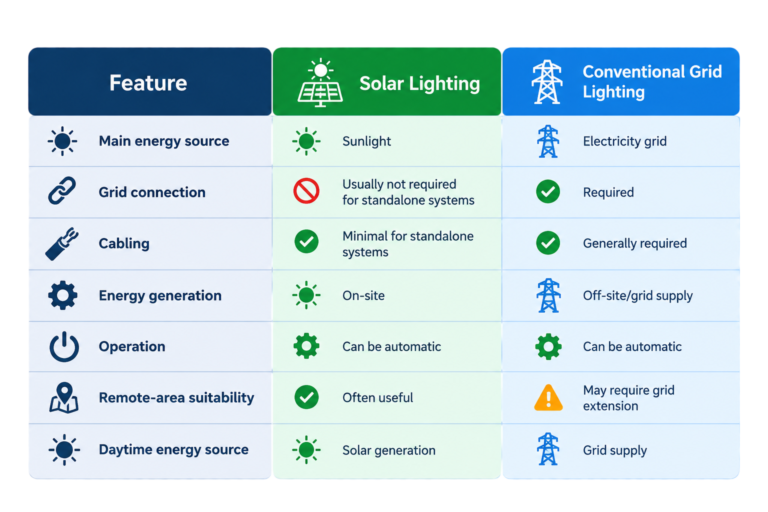
Rather than asking, “Which system is always better?”, a more useful question is: **What does this particular location need?**
For a new road in an area without electrical infrastructure, the answer may differ from that for an established urban road with existing utility connections.
Why Professional Solar Installation Matters
A good solar lighting product can still perform poorly if it is incorrectly sized or installed.
For example, imagine installing a high-output LED on a pole where the panel receives heavy afternoon shade. The light may look impressive on paper, but the battery may not receive enough energy to support the expected operating schedule.This is why professional planning matters.An experienced solar installer can help evaluate:
Lighting requirements
- Panel capacity
- Battery sizing
- Pole spacing
- Mounting height
- Solar exposure
- System controls
- Installation conditions
- Maintenance requirements
For customers in Pune and surrounding areas, Sailee Solar provides solar solutions designed around individual project requirements rather than simply offering a standard package.You can also explore the website’s Solar System Installation service page to understand the broader solar installation solutions available.
If you are considering solar for your home or business, you may also want to learn more about [Rooftop Solar] and the [PM Surya Ghar] scheme before planning your complete solar project.
Rather than asking, “Which system is always better?”, a more useful question is: **What does this particular location need?**
For a new road in an area without electrical infrastructure, the answer may differ from that for an established urban road with existing utility connections.
FAQs Solar Street Lights
The operating duration depends on battery capacity, panel size, LED power, weather conditions, lighting settings, and the overall system design. Many systems can be configured for different nighttime schedules.
Yes, they can operate during monsoon conditions because energy is stored in the battery. However, prolonged cloudy weather can reduce solar generation, so proper panel and battery sizing is important.
Standalone solar lighting systems generally do not need a connection to the electricity grid for normal operation. They generate and store their own energy.
Yes, solar pumps can be designed for borewell applications. The correct pump must be selected according to borewell depth, water level, required flow, and total pumping head.
The frequency depends on dust, pollution, rainfall, and the surrounding environment. In dusty locations, periodic cleaning can help maintain energy generation.
The frequency depends on dust, pollution, rainfall, and the surrounding environment. In dusty locations, periodic cleaning can help maintain energy generation.
Yes. Some solar lighting systems can incorporate motion sensors or intelligent controls. These can adjust lighting based on movement and help manage energy consumption.
The initial cost can be higher than simply installing a conventional lamp on an existing electrical connection. However, the overall economics depend on electricity costs, cabling requirements, maintenance, system lifespan, and installation conditions.