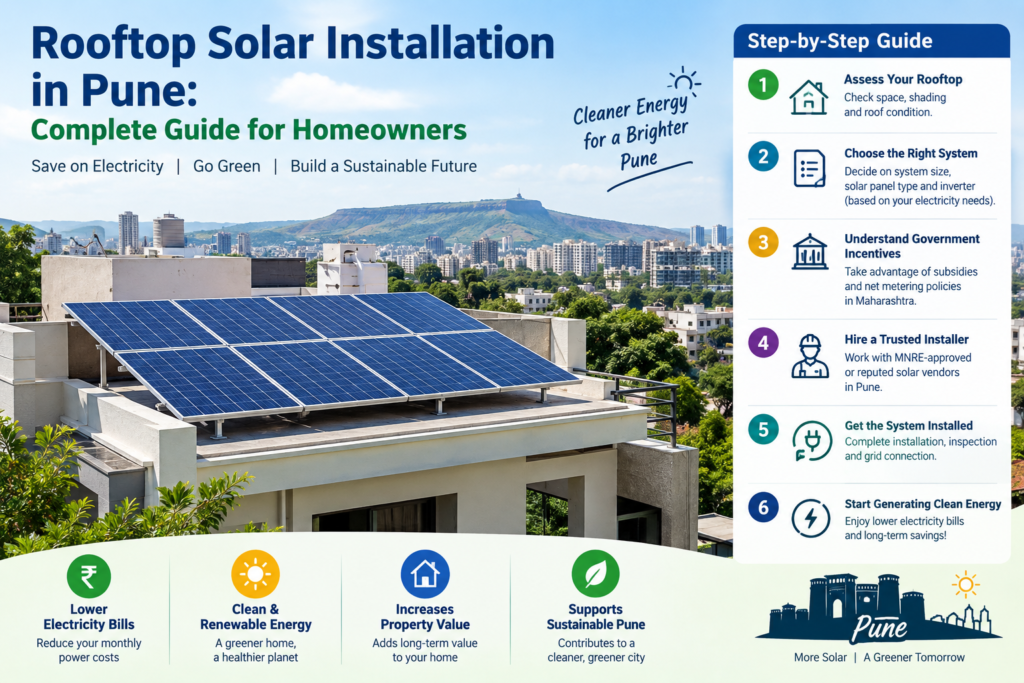
Electricity bills can take a significant bite out of a household budget, especially during Pune’s hot summer months when fans, air conditioners, and refrigerators run for longer hours. If you are looking for a practical way to manage your electricity expenses, rooftop solar is worth considering.
Thank you for reading this post, don't forget to subscribe!
Rooftop Solar Installation in Pune: Complete Guide for Homeowners explains everything you need to know before investing in a solar power system, from choosing the right capacity to understanding installation, government subsidies, and long-term savings.
Pune reeives abundant sunshine throughout much of the year, making rooftop solar a practical option for many residential properties. Whether you live in a bungalow in Wakad, an independent house in Baner, or a housing society in Pimpri-Chinchwad, a properly designed solar system can help reduce your dependence on electricity purchased from the grid.
Let’s explore how to make the right decision for your home
Why Choose Rooftop Solar Installation in Pune?
Solar energy allows homeowners to generate electricity using sunlight instead of relying entirely on the conventional power supply. Once your system is installed and commissioned, it can generate electricity for many years with appropriate maintenance.
1.Reduce Monthly Electricity Bills
Solar panels generate electricity during daylight hours. When your home consumes this electricity, you may need to purchase less power from the grid.
For example, imagine a family in Pune paying ₹3,000 per month for electricity. A suitably sized solar system could reduce its grid electricity purchases considerably, depending on daytime consumption, system performance, applicable tariffs, and net-metering arrangements.
Actual savings vary from home to home, so a site assessment and electricity-bill analysis are essential.
2.Make Better Use of Your Rooftop
Your rooftop can do more than provide shelter. With suitable sunlight, sufficient space, and a structurally sound roof, it can become a small power-generating asset for your household.
3.Support a Cleaner Environment
Solar electricity generates no direct greenhouse gas emissions while operating. Choosing rooftop solar can therefore help reduce your household’s reliance on electricity generated from fossil fuels.
4.Improve Long-Term Energy Planning
Electricity tariffs, household requirements, and consumption patterns can change over time. Generating some of your own electricity gives you greater control over your energy use.
For many homeowners, Rooftop Solar Installation in Pune is not simply a home improvement project; it is a long-term investment in energy management.
Rooftop Solar Installation in Pune: Choosing the Right System Size
One of the first questions homeowners ask is, “How many solar panels do I actually need?”
The answer depends on your electricity consumption, available rooftop space, roof orientation, shading, and the type of system you choose.
How to Estimate Your Solar Requirements
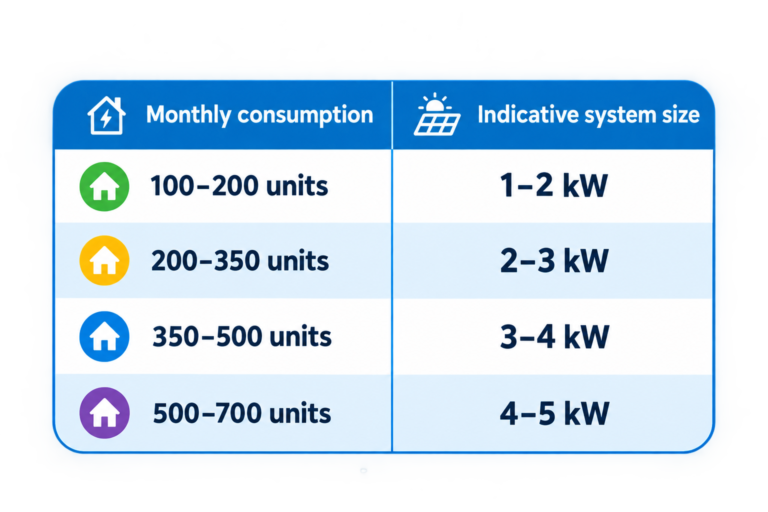
Start by reviewing your latest electricity bills. Look at your monthly consumption in units (kWh), rather than relying only on the bill amount.
The following table provides a general starting point.
These are preliminary estimates, not guaranteed recommendations. The appropriate capacity must be calculated using actual consumption, local solar conditions, usable roof area, and applicable regulations.
Types of Rooftop Solar Systems
On-grid solar : Connected to the electricity grid. It is generally suitable for homes seeking to reduce grid electricity purchases. Standard on-grid systems shut down during a grid outage unless specifically designed and approved for backup operation.
Off-grid solar : Uses batteries to store energy and can serve suitable loads independently of the grid. Battery capacity and backup duration must be planned carefully.
Hybrid solar : Combines grid-connected operation with battery storage, where supported by the equipment and applicable requirements. It can provide backup for selected loads when configured correctly.For many urban homes in Pune, an on-grid system is a useful starting point. However, households that need backup during power cuts may prefer to evaluate hybrid or off-grid options.